
Have you ever thought you don't need heavy weights to build strong legs? You can boost your strength, endurance, and tone by using your body's own weight. In just 25 minutes, simple moves like squats and lunges work hard on your quads (the muscles on the front of your thighs), hamstrings (the muscles on the back of your thighs), and glutes (your butt muscles). It's an easy, fresh approach that lets your body do the work without any extra equipment. Ready to feel a refreshing burst of energy while improving your mobility? Let's dive into how these exercises build a strong, toned lower body.
Comprehensive Bodyweight Leg Training Routine for Strength, Endurance, and Tone
This quick 25-minute workout needs no equipment and is perfect for boosting leg strength, endurance, and tone while also improving your overall mobility. You can step up your game by changing the number of reps or varying the speed at which you do each move, so your muscles keep getting a fresh challenge.
This routine includes seven exercises that focus on your quads (front thigh muscles), hamstrings (back thigh muscles), glutes (butt muscles), calves, and inner thigh muscles (adductors).
| Exercise | Primary Muscle Focus | Sets/Reps | Duration/Notes |
|---|---|---|---|
| Bodyweight Squats | Quads, Hamstrings, Glutes | 3 sets of 12-15 reps | – |
| Forward Lunges | Quads, Glutes | 3 sets of 12-15 reps per leg | – |
| Glute Bridges | Glutes, Hamstrings | 3 sets of 12-15 reps | – |
| Step-Ups | Quads, Glutes | 3 sets of 12 reps per leg | – |
| Split Jumps | Quads, Calves | 3 sets of 12-15 reps | – |
| Skaters | Adductors, Glutes | 3 sets of 12-15 reps per side | – |
| Wall Sits | Quads, Hamstrings | 3 sets | 30-second hold |
Try to do this workout two or three times each week. This schedule helps you steadily build strength while giving your muscles time to rest and recover. As you grow stronger, feel free to add a few extra reps or take short pauses during the exercises to keep things challenging and effective.
Dynamic Warm-Up Strategies for Bodyweight Leg Training

Before jumping into your leg workout, it really pays off to get your muscles warmed up. A good dynamic warm-up boosts your mobility, gets blood flowing, and even cuts down the chance of injury. It’s like giving your quads, hamstrings, glutes, and hip stabilizers a gentle wake-up call. Imagine feeling that light buzz of energy gradually building up as you prepare for what’s ahead.
- Overhead Squats – Stand tall with your feet about shoulder-width apart and lift your arms up high. Slowly squat down to stretch out your hips and shoulders. Try to hold for about 30 to 45 seconds.
- Single-Leg Reach – Balance on one leg and carefully stretch out the opposite arm and leg. This move helps make your hips more flexible and improves your balance. Do this for 30 to 45 seconds on each leg.
- Lateral Steps to High Knee – Step to the side, then lift your knee high as you switch direction. This exercise fires up your glutes and hip muscles. Keep the motion continuous for 30 to 45 seconds.
- Hip Circles – Place your hands on your hips and swing them in wide, controlled circles. This is a great way to loosen up your lower back and hips. Stay in the groove for 30 to 45 seconds.
Adding these warm-up moves just before your main workout helps your body slip into exercise mode. You get prepped for a leg session that feels both strong and smooth.
Fundamental Bodyweight Leg Exercises and Proper Form
Starting out with leg exercises using your own body weight is a smart way to build strength and learn proper form. Each exercise is designed to target specific muscles and set a solid base before you move on to more advanced routines.
Bodyweight squats work your quads, hamstrings (the muscles at the back of your thighs), and glutes. Stand with your feet shoulder-width apart and keep your chest up. Slowly bend your knees and lower your body until your thighs are parallel to the floor. Try for 15 to 20 smooth repetitions. A common slip-up is letting your knees go inward. Instead, gently push them out as you squat, much like sitting back into an invisible chair. This steady movement helps keep your balance and protects your joints.
Forward and reverse lunges are also great for your quads and glutes. For a forward lunge, take a step of about 2 to 3 feet ahead and bend both knees, making sure your front knee stays behind your toes. In a reverse lunge, step backward instead. Aim for 12 to 15 reps on each leg. Keep your back straight, as if you are holding a book close to your chest, to avoid unnecessary strain on your lower back.
Glute bridges are excellent for your backside muscles. Lie on your back with your feet flat on the ground, spaced about hip-width apart. Then, lift your hips up until your body forms a straight line from your knees to your shoulders. Do 15 to 20 reps, taking care not to let your lower back sag. Keeping your core engaged makes the exercise more effective and safe.
Step-ups on a sturdy platform are perfect for boosting balance and strengthening each leg on its own. Step up with one leg, pushing through your heel, then bring the other leg up so you are standing fully. Step back down slowly and repeat for 3 sets of 12 reps per leg. Maintaining a controlled pace and breathing evenly will help you get the most from each move.
Progressive Overload Techniques for Bodyweight Leg Training
Progressive overload is all about steadily challenging your muscles so they grow stronger and more toned. In simple terms, it means nudging your body a little further each time, whether by adding more reps, slowing down your movements, or trying a tougher version of your favorite exercise. This steady push helps your muscles adapt and thrive.
One clear way to do this is to boost your repetitions by 2 to 5 each week. So, if you start off with 15 squats, aim for 17 to 20 as your strength builds. You can also play with your tempo; try holding the squat at the bottom for 2 to 3 seconds or slowly lowering down over 3 to 4 seconds. These little pauses make your muscles work extra hard, even without any added weight.
Another smart move is to mix in exercises that focus on one leg at a time, like split squats. This helps even out any strength differences between your legs while making each side work its hardest. Plus, tossing in isometric holds, for instance, holding a lunge for 30 to 60 seconds, can really intensify your workout without needing any additional equipment.
Keep a simple log of your workouts. Writing down your sets, reps, and any tweaks in your tempo will give you a clear picture of your progress. Over time, you’ll be able to see how small changes add up to big gains.
Advanced Variations and Plyometrics in Bodyweight Leg Training
Adding advanced moves to your workout is a fun way to boost your power and get more out of every exercise. These energetic drills build strength and also help improve your balance and coordination, making each session feel dynamic and effective.
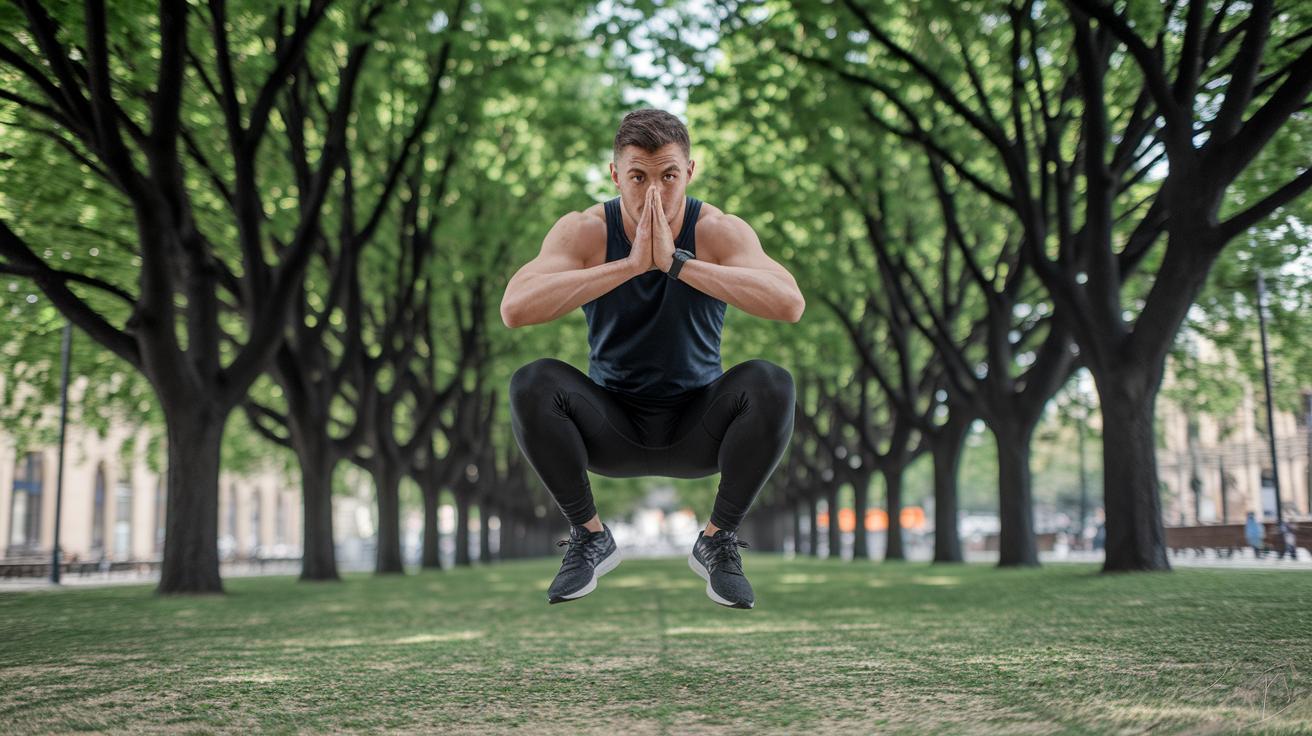
Try squat jump tucks for a quick burst of energy. Begin in a low squat, then jump up with as much power as you can. As you rise, tuck your knees to your chest before landing softly. Aim for 8 to 12 jumps per set. Picture yourself as a nimble cat leaping gracefully, always landing with control.
Next, jump lunges ramp up the challenge by switching legs in mid-air. Push off strongly from each side and focus on driving your knee upward while landing gently. Complete 10 jumps on each side. Each jump feels like a mini explosion that not only builds strength but also tests your stability and keeps your core engaged.
Try eccentric Bulgarian split squats to mix slow and fast moves. Lower yourself over a slow count of four, then drive up quickly with energy. Aim for 8 to 10 reps per leg. This approach helps you master muscle control on the way down and tap into your power as you rise.
Incorporate these plyometric drills into your weekly routine one or two times to really boost muscle growth and power. Allow yourself 30 to 45 seconds of rest between sets so you can keep each move strong and focused.
Integration of Bodyweight Leg Training into Full-Body Routines

Bodyweight leg training is a fantastic way to boost your overall strength, especially when mixed with upper-body and core exercises. When you alternate between legs, arms, and abs, you feel that refreshing burst of energy with every workout, and your body keeps burning calories all through the session.
Imagine spending one day focused on leg moves like squats, lunges, and some quick plyometric drills that really get your heart pumping. Then on another day, you pair in upper-body push and pull exercises alongside a solid core circuit. It’s a method that not only feels balanced but also gives each muscle group the time it needs to recover while still keeping up the intensity.
A sample weekly schedule might look something like this:
- Monday: Leg day – Think squats, lunges, and a short EMOM block where you do 45 seconds of a leg drill followed by 15 seconds of push-ups.
- Tuesday: Upper-body exercises focusing on pushing and pulling.
- Wednesday: Core circuits combined with a bit of light leg work.
- Thursday: A rest day or some active recovery to keep things loose.
- Friday: Another leg day with different plyometric moves to mix it up.
- Saturday: Back to upper-body work and core strengthening.
- Sunday: Rest to help your body recharge.
This balanced routine lets you work different muscle groups without overworking any single one. You can always tweak the number of reps or the timing of your EMOM intervals to match your comfort level and energy. Have you ever noticed how small adjustments can lead to big improvements? Enjoy the process and let your body shine in every part of your full-body workout.
Recovery and Cool-Down Tips for Sustained Bodyweight Leg Training
After a tough leg workout, it's really important to wind down properly. A few minutes of light cardio, like jogging in place for about 2 to 3 minutes, gently lowers your heart rate and helps deliver nourishing blood to your tired muscles.
Once you're feeling more settled, try some static stretching. Holding stretches for your quads, hamstrings, and calves for around 30 seconds each can ease muscle tension and boost your flexibility.
For a little extra joint care, hip flexor lunges keep your hips mobile, while isometric moves like wall sits for 45 to 60 seconds and glute bridge holds for 30 to 45 seconds help build muscle endurance.
Finish your cooldown with foam rolling on your quads and IT bands. This simple technique helps smooth out tight spots and encourages muscle recovery. And on your off days, opt for gentle activities that keep your muscles engaged without overworking them.
Final Words
In the action of sharpening your workout routine, this guide delivered a complete view of bodyweight leg training. You explored an efficient warm-up, detailed exercise instructions, and ways to safely challenge muscles with progressive overload. The practical breakdown of fundamental exercises, advanced variations, and recovery techniques makes it easy to boost strength and tone at home.
Enjoy applying these tips to feel more energized and balanced every day. Here's to taking small steps toward big improvements in overall wellness!
FAQ
What is a 30-minute bodyweight leg workout like?
The 30-minute bodyweight leg workout uses seven distinct exercises that target quads, glutes, hamstrings, and calves, offering a quick yet balanced routine designed to boost strength and tone at home.
Can bodyweight leg exercises build muscle mass without weights?
Bodyweight leg exercises build muscle mass by challenging key muscles with higher repetitions and controlled tempos, making it possible to stimulate strength gains even without using extra weights.
Are bodyweight leg workouts at home suitable for beginners?
Bodyweight leg workouts at home are designed with beginners in mind, incorporating basic moves like squats and lunges along with progressions that help build lower-body strength safely and steadily.
Is a 20-minute leg workout effective for achieving strength and tone?
A 20-minute leg workout is effective when structured with purposeful, high-intensity movements that challenge muscles consistently, making it a great option for boosting strength and endurance in a limited time.
Are seven exercises enough for a complete leg training routine?
Seven well-chosen exercises can provide a complete leg training routine by targeting different muscle groups, promoting balanced strength, muscular endurance, and overall leg tone without overcomplicating the session.
What does a bodyweight leg extension entail?
A bodyweight leg extension involves modifying moves like squats or lunges to mimic the extension motion, engaging the quadriceps and stabilizer muscles even without traditional gym equipment.
sildenafil prescriptions online
sildenafil prescriptions online
cialis medication interactions
cialis medication interactions
cenforce online
cenforce online
semaglutide 14 mg tab
semaglutide 14 mg tab
fincar tablet uses in tamil
fincar tablet uses in tamil
sildenafil cream reviews
sildenafil cream reviews
ozempic costco price
ozempic costco price
acyclovir cream 5 5gm/tube
acyclovir cream 5 5gm/tube
ketorolac tromethamine profile
ketorolac tromethamine profile
toradol migraine treatment info
toradol migraine treatment info
ivermectin PK comparison
ivermectin PK comparison
minoxidil clinical insights
minoxidil clinical insights
sildenafil packaging integrity
sildenafil packaging integrity
sildenafil online vs local pricing
sildenafil online vs local pricing
vardenafil 10 mg review
vardenafil 10 mg review
vardenafil 5 mg strength info
vardenafil 5 mg strength info
Meal Effects on Sildenafil
Meal Effects on Sildenafil
Duration Variability Framework
Duration Variability Framework
Viagra vs sildenafil performance
Viagra vs sildenafil performance